

Roses, language, and real life: exploring Arabic culture in Saudi Arabia

Students visit the desert near Makkah, admiring the iconic sight of camels crossing the golden sands.

Steven, on the far left, with other EdUHK students attending an Arabic language class at Umm Al-Qura University.

EdUHK delegation meets the UQU President and Vice President. Steven Wong Fat-shing is on the far left, and Samuel Wong Man-tak is fourth from the left.

Steven, fifth from the left, and Samuel, seventh from the left, with other members of the exchange programme after a visit to the Faculty of Medicine at Umm Al-Qura University.
Two students from the Faculty of Liberal Arts and Social Sciences (FLASS) together with eight students from the Faculty of Humanities, participated in a credit-bearing Summer Arabic Language Programme in July, offered by Umm Al-Qura University (UQU) in Makkah, Saudi Arabia. The programme was specially designed for beginners, aiming to develop proficiency in Arabic language skills, including listening, speaking, reading, and writing.
Complementing their language studies, the students also had the opportunity to explore Saudi Arabia’s rich history and cultural traditions through a series of immersive excursions and activities. During visits to Jeddah and Taif, they gained insights into the nation’s focus on nurturing talent, fostering scientific innovation, and preserving its vibrant cultural heritage. They also learnt about the Mawhiba Programme, an initiative aimed at empowering youth and promoting innovation and sustainable development.
Dr David Kang, Director of General Education, led the ten EdUHK students from 4 July to 2 August for the exchange programme. The two FLASS participants were Steven Wong Fat-shing, a fourth-year student in the Bachelor of Education (Honours) (Secondary) - Information and Communication Technology (BEd(S) – ICT) programme and Samuel Wong Man-tak, a 2025 graduate from the Bachelor of Science (Honours) in Integrated Environmental Management (BSc(IEM)) programme.

Steven, far left, and other students choosing their favourite rose-based perfume after visiting a rose factory in Taif, a city in Mecca Province famed for its fragrant roses and perfume production.

Steven, right, with an Arabic language teacher from Umm Al-Qura University (UQU). He said the Arabic teachers he met at UQU were highly skilled and patient in teaching the language.
But once I mastered some basic phrases for greeting locals in markets, my apprehension turned into excitement.
Like many Hong Kong students, both Steven and Samuel had little knowledge of Arabic before the exchange. “I felt anxious at the beginning of the exchange. But once I mastered some basic phrases for greeting locals in markets, my apprehension turned into excitement. Teachers at UQU patiently corrected my pronunciation during drills and helped me understand the basic structure of the Arabic language,” Steven shared.
Alongside intensive language lessons, the exchange included cultural trips during weekends. “In Taif’s farms, I saw Arabian traditions come to life. Known as the City of Roses, Taif is home to many rose factories that produce some of the world’s finest rose products. The visit to Jeddah, a city on the eastern shore of the Red Sea, revealed the region’s rich historical past. In Jeddah, we listened to traditional oud melodies and felt the poetic rhythm of the Arabic language. The experience linked language and culture in a profound way, showing how music reflects the cadence of the language,” he said.

Jeddah’s Bayt Nassif Museum offers a blend of traditional architecture and captivating exhibits. Inside, students explore the rich heritage of Saudi Arabia.

Samuel with two Arabic language teachers from UQU.
All aspects of the language, including letters, sentence structure, grammar, and greetings, are influenced by religion, which makes it more challenging for a non-Muslim like me to learn.
A desire to understand the rich history and culture of the Arab world motivated Samuel to enroll in the summer programme. “As Middle Eastern countries gain global prominence, Arabic becomes increasingly important. Proficiency in it allows me to better understand the region’s rise and gives me an advantage in seeking overseas opportunities,” he said. Samuel noted that Arabic is deeply rooted in the Muslim faith. “All aspects of the language, including letters, sentence structure, grammar, and greetings, are influenced by religion, which makes it more challenging for a non-Muslim like me to learn,” he remarked.
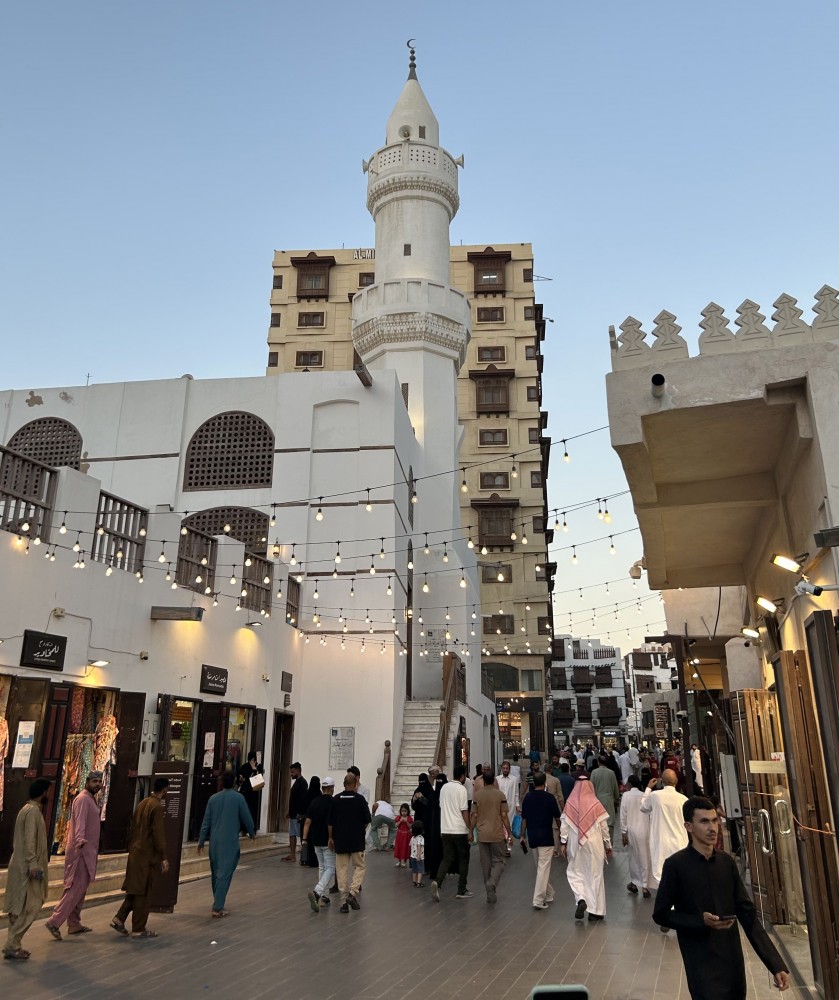
During the exchange, EdUHK students also observed local classes. Samuel felt the dedication of Saudi students to achieving the highest academic standards. The experience broadened his understanding of education and youth development in the country. “The cultural excursions were equally enriching. The visit to Old Jeddah was a highlight, deepening my understanding of the nation’s heritage, and architecture, and traditions. Over the four-week programme, we explored bustling markets, listened to local storytellers, and discovered the role of Arabian music. These experiences offered valuable insights into how history and tradition have shaped the country’s identity,” Samuel said.
The programme ignited a passion among many EdUHK students to continue exploring Arabic language and culture. Steven and Samuel are keen to deepen their cultural knowledge and seek opportunities for cross-cultural engagement. “The combination of rigorous language instruction, immersive trips to Taif and Jeddah, and soulful music-sharing sessions was transformative. I’m eager to further my linguistic and cultural understanding of this fascinating and rapidly emerging region, which holds immense potential for young graduates like us,” Steven said.
The exchange underscored the mutual commitment of EdUHK and Umm Al-Qura University to promoting internationalisation and strengthening global collaboration. In return, EdUHK hosted 10 students from UQU, accompanied by Dr Majed Mahmood Farrash, Head of the Computer Science and Artificial Intelligence Department of the Saudi Arabian university. Students from UQU joined the newly launched four-week Summer Short-term Programme 2025. This collaboration highlights EdUHK’s growing strategic engagement in the Middle East, with the aim of positioning Hong Kong as an international hub for education.
